An AI note-taker for therapists that never sends a session anywhere
Therapists lose evenings to paperwork, and every AI scribe that helps uploads session audio to a vendor. TheraScribe records a consented session, transcribes it, and drafts the note entirely on the therapist’s laptop. I built the working prototype on top of an open-source medical scribe.
Problem
AI scribes save therapists hours, but every one uploads session audio to a vendor and costs up to $120 a month.
Insight
For this buyer, where the data goes is the purchase decision. If nothing leaves the laptop, there is no third party to trust.
Decision
Local by default, no recording without consent, and the AI drafts but never advises.
Result
Working prototype: consent gate, local drafting in four note formats, private notes kept apart. Not used with real clients.
Where the data goes: nowhere
Every step of the core loop runs inside the dashed line.
The therapist’s laptop
01Who it’s for
02The problem
Documentation is a major driver of therapist burnout. AI scribes help, but every one is a cloud service.
Session audio goes to the vendor, the therapist signs a contract (a BAA) trusting them with health data, and pays about $14 to $120 a month. Therapists who are privacy-conscious, price-sensitive, or just uneasy about uploading recordings had no good option.
03The insight
Where the data goes is the product.
If recording, transcription, and drafting all happen on the laptop, there’s no vendor holding the data and no vendor contract for that work. I was also careful about what not to claim. Local processing doesn’t make software “HIPAA compliant,” because compliance belongs to the whole practice. The claim I can defend is narrower: nothing leaves the device.
04How I measured success
What I optimized
A real session to a saved, edited note, with nothing leaving the laptopPlus: a non-technical therapist can install and set it up alone from a signed installer.The obvious metric I rejected
Feature parity with the cloud scribesThey’ll always have more features. The wedge is privacy and price.05Product tour
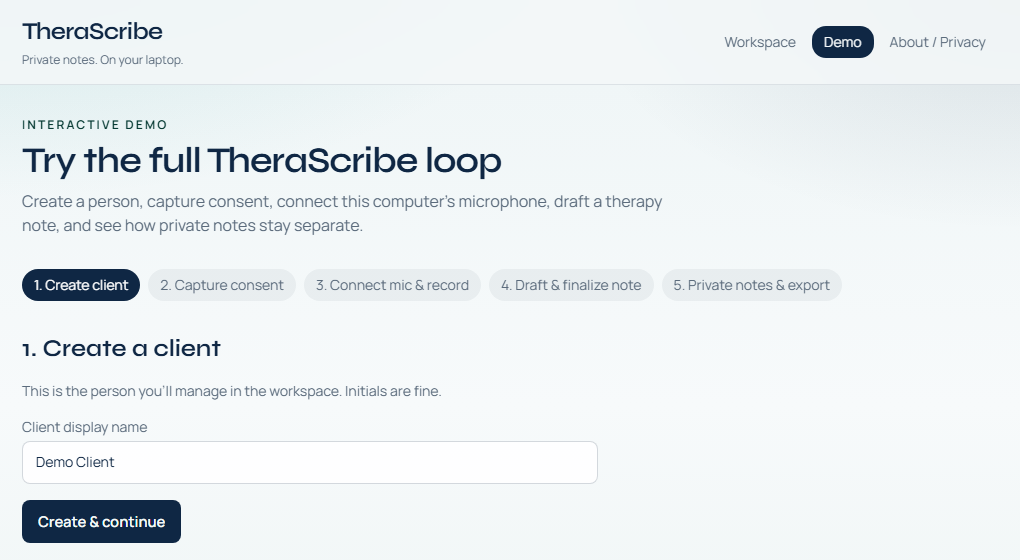
The guided demo
Five steps: client, consent, record, draft and finalize, private notes.
06Decisions
- Why
- OpenScribe was MIT licensed, already ran on Mac and Windows, and already had a local transcription path and encrypted storage. My time went into the therapy-specific layer.
- Instead of
- Building recording and transcription myself, or forking a project without Windows support.
- Cost
- I inherit its structure and keep its license notices.
- Why
- About a dozen states, including California, require every party to agree before recording, and therapy ethics codes require written consent. The app enforces it.
- Instead of
- A reminder checkbox the therapist can skip.
- Cost
- One more setup step per client.
- Why
- The model summarizes and structures what was said. It never suggests a diagnosis or treatment, which would push toward medical-device rules and clinical liability.
- Instead of
- AI suggestions that look impressive in a demo.
- Cost
- Less “wow” than competitors.
- Why
- Federal rules protect a therapist’s private psychotherapy notes more strictly than the progress notes in the record. They’re stored separately and never exported with the record.
- Instead of
- One note with a private section.
- Cost
- A more complex data model.
07What I left out
| Left out | Why |
|---|---|
| Cloud processing or sync | Off by default. Any cloud option would bring back the vendor contract. |
| Billing, scheduling, insurance | It sits beside the therapist’s records system, not instead of it. |
| Group practices | Solo, single laptop first. |
| Automatic recording | Recording is always explicit and consented. |
08The business case
I wrote the model before building: a free, open core for the whole scribe loop, and a paid layer for what this buyer can’t do alone. That meant a one-click installer, updates, and support at roughly $10 to $20 a month, well under the cloud tools, with a paid compliance pack on top.
I ruled out per-session pricing, which recreates what it’s meant to beat, and ads or tracking, which would poison a privacy product. Today it’s an open reference project, and commercializing it isn’t the goal. The model is there if real therapists ever pull it in that direction.
09What happened
I built six of the ten planned stages: local-only defaults, an encrypted database, client management, the consent gate, constrained drafting in four note formats with a log of AI draft versus human edit, and separated private notes.
Speaker separation, a passphrase-derived encryption key, and signed installers aren’t done. It hasn’t been used with a real client, and it shouldn’t be until security hardening and a compliance review are finished.
10What’s next
- Finish security hardeningApp lock, a key derived from the passphrase, and encrypted backup. Required before any real session.first
- Separate the speakersA note is only as accurate as knowing who said what.then
- A signed installer, then five therapistsMeasure setup without help, and whether they’d trust it with a real session.then