Meal prep from local chefs, matched to your diet
Busy people want to eat well without spending Sunday cooking. Local chefs want steady customers. Plate Plan connected the two: tell it your diet, goal, and budget, and get a week of meals from nearby chefs in one checkout. I built and ran it on my own for 13 months.
Problem
People know what eating well looks like. They can’t sustain the hours of planning, shopping, and cooking it takes.
Insight
The hard part wasn’t food. It was the match. Both sides have to win on the first order.
Decision
Start from the goal, recommend only what a nearby kitchen can deliver, and design for the second order.
Result
About half of customers reordered. I stopped because the margin only worked at a scale I didn’t want to raise money for.
The match, from the eater’s side
Screen from yourplateplan.com. The right side is the matching workflow behind it.
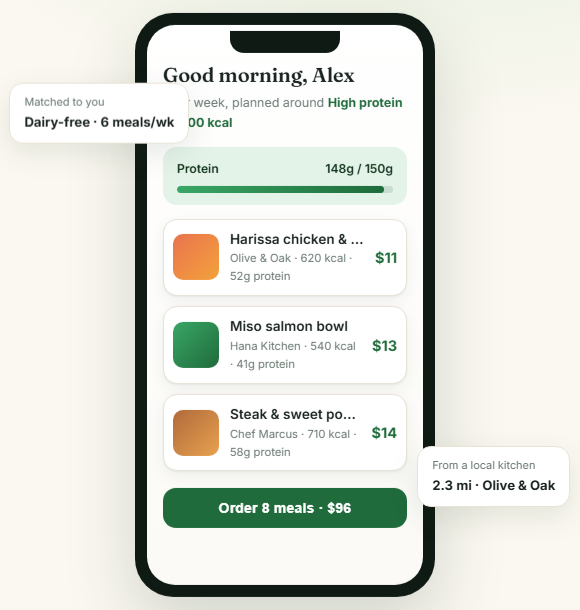
- Goal and diet intakeProtein target, allergens, budget, portions.
- Constraint filterDrop anything no local kitchen can actually serve.
- Provider matchRank nearby chefs by fit and distance.
- Weekly menuMacro-labeled meals, ready to order as a week.
01Who it’s for
02The problem
“Wanting to eat well is easy. Finding the time isn’t.”
Grocery runs, planning, prep, and cleanup eat hours every week, and they’re the first thing to break on a busy schedule. Meal kits still mean cooking, with little customization and a premium price. Delivery apps are built for tonight, not for a goal.
03The insight
The hard part wasn’t food. It was the match.
A marketplace only works when both sides win on the first interaction. The eater has to get meals that fit their goal from a kitchen that can actually deliver them, and the kitchen has to get an order worth making. Every product decision pushed toward a confident first match and a repeatable second order.
04How I measured success
What I optimized
The second order: did a customer come back for another weekRepeat weeks decide whether a meal marketplace lives or dies, for eaters and for kitchens counting on steady orders. It came in at about 50%: a small group of happy customers who kept ordering.The obvious metric I rejected
Sign-upsEasy to grow, and meaningless if nobody orders a second week.05Decisions
- Why
- Most food apps make you browse. Plate Plan asked for the goal first, then showed only meals that move someone toward it. Fewer choices, more conviction.
- Instead of
- A browsable menu of everything nearby.
- Cost
- Less room for discovery.
- Why
- I marketed through gyms. Gym-goers already track protein and plan meals, so a goal-first intake spoke their language from the first screen.
- Cost
- A narrow funnel that wouldn’t carry the business on its own.
- Why
- Personalization is worthless if no nearby kitchen can fulfill it. Matching was limited to real partner menus within range, so every recommendation was orderable.
- Instead of
- Showing the ideal meal plan and hoping supply catches up.
- Cost
- Thinner choice wherever partners were sparse.
- Why
- Ordering a whole week in one checkout, with a dashboard for repeats, turned a one-off purchase into a weekly habit. An 8-meal week was $96.
- Instead of
- Selling single meals.
- Cost
- Asks for more commitment up front.
06How it went
- Customer discoveryInterviews with busy professionals and students to test the time-versus-nutrition tension.Oct to Dec 2024
- Build and onboardShipped the marketplace, intake, and Stripe checkout. Signed the first local kitchens.Jan to Mar 2025
- Live operationsAbout 50 paying customers, mostly through gyms. Half of them reordered.Apr to Sep 2025
- Wind-downClosed it on the economics, not the demand.Oct 2025
07Why I stopped
Retention proved people wanted it. The margin decided it wasn’t a business I should raise money for.
About half of customers reordered, a small group of happy, repeat customers. But each order carried a small margin. The only way to a real business was scale, which meant competing head-on with mainstream delivery apps and raising a lot of money to do it.
I didn’t want to raise, I didn’t see good odds of a return on that money, and I needed income. So I wound it down and took a full-time job. The lesson I carry: test the unit economics as early as you test demand.