Product Case Study
Telos
Telos is an AV safety review platform: it turns the review of autonomous-vehicle and fleet safety events, a months-long, six-figure manual process, into an evidence-backed diagnosis anyone with oversight responsibility can produce in under a minute.
It started in a working session with the DMV, where I saw that the agencies responsible for AVs had no real way to see or make sense of the edge cases, the moments where autonomous driving goes wrong in the real world. I conceived Telos to close that gap and built it solo at Advanced Mobility Group, a smart-transportation consultancy where I worked as a technical consultant. Carrying it from problem framing to system architecture to pricing is what made me a full-stack product manager. I demoed it to a California county's transportation authority and three of its cities, the cities asked to bring it into their streets, and AMG then moved to take it in-house and sell it directly.
Advanced Mobility Group · Walnut Creek, CA · Sept 2025 to present · product name changed for this writeup
The Problem
AV and fleet safety is reviewed backward. The people responsible for overseeing automated and human driving on public streets, regulators, transportation authorities, and the city engineers who answer to them, act on a dangerous corridor only after someone is hurt, through a study that runs four to six months and costs six figures. The near-misses that predict the crash go uncaptured in that process, and the reviewers are not data analysts: a complaint or an incident report comes in, and there is no fast way to tell whether a corridor or an operating area is genuinely dangerous.
The data already exists, AV and fleet telemetry, camera footage, weather, road conditions, traffic. The problem was never collection, it was usability, a faster thing to solve and a sharper wedge.
Everything an oversight decision needs is already being recorded. Nothing fuses it into something a non-technical reviewer can act on.
The Wedge: Start Where the Data Lives
The end customer for safety review is oversight: regulators and the public agencies that answer to them. But the fastest path to proof was not a state agency's procurement cycle, it was the layer below, where sensors were already deployed and the need was immediate. AMG sat in exactly the right place to reach it, positioned as the Contra Costa Transportation Authority's main technical consultant. CCTA is a county authority with a line into all 19 of its cities, teams of one to four people running whole street networks, with a backlog of dangerous locations they could not fund without evidence. That relationship was an unfair entry into the market, and every deployment there produces exactly the reviewed, evidence-backed record an oversight body needs. The wedge worked: the platform went on to reach the oversight layer itself.
What I Built
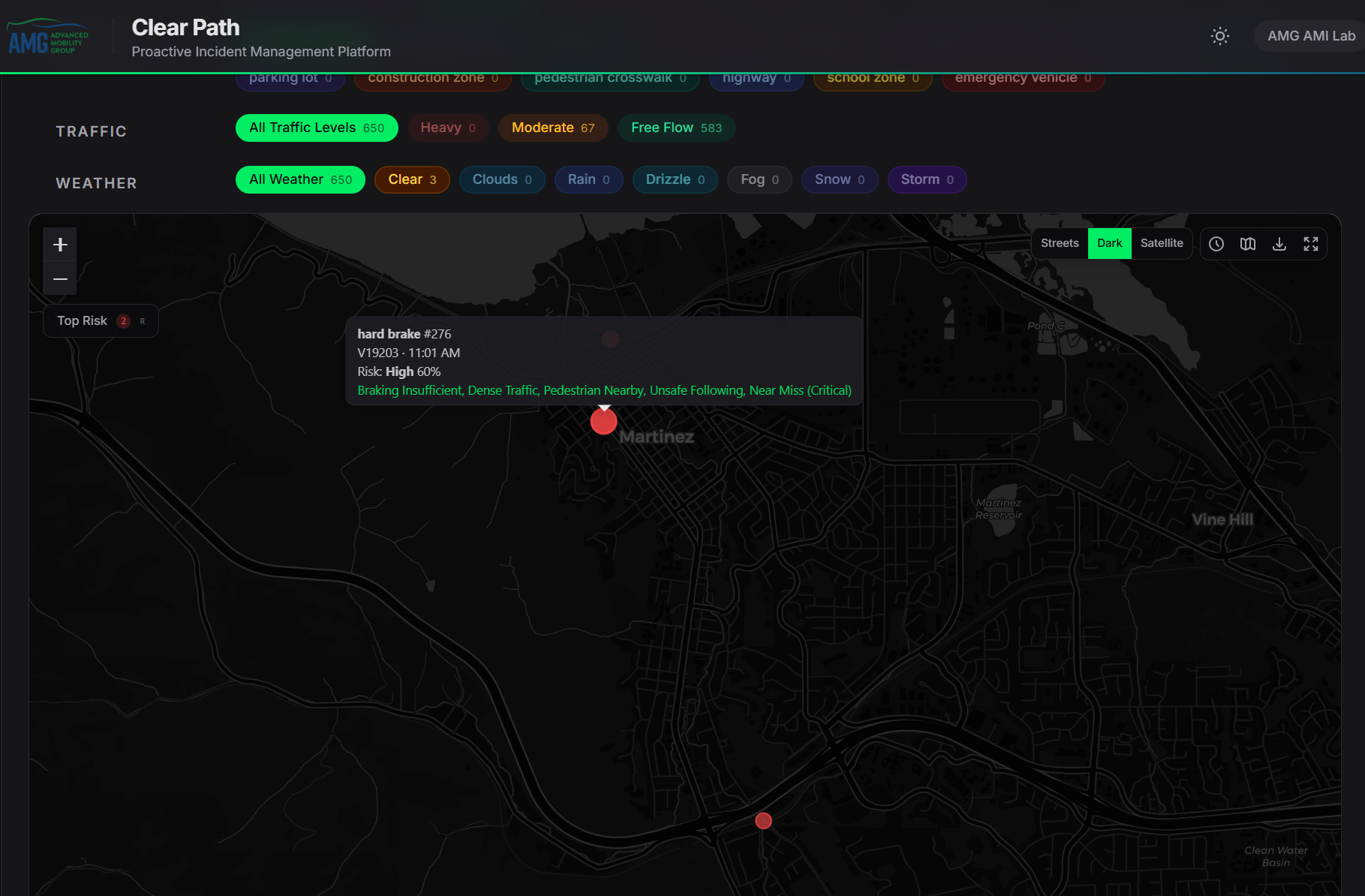
One near-miss (hard brake #276, Martinez CA) surfaced out of 650 events, scored by physics-based risk, with its factors fused into one view: braking insufficient, dense traffic, pedestrian nearby, unsafe following.
A platform that takes a safety reviewer from "something happened on this corridor" to "here is the proven problem and the evidence to act on it" in under a minute:
- Risk score (time-to-collision, RSS) ranks every event by danger, so the worst one surfaces first. Bigger and redder on the map means closer to harm.
- Data fusion pulls every source, telemetry, camera, weather, road context, into one event view and kills the hours of manual stitching.
- Hotspots cluster events so a reviewer sees which corridor concentrates the risk.
- Situation search filters the map by safety scenario: near-misses, hard braking, intersections, school zones, railroad crossings, pedestrian crossings.
- Export produces a defensible, evidence-backed report in one click, the artifact an oversight decision actually runs on.
Priced at $1,000/month/city, deliberately under the threshold that triggers full procurement, so I could get in and prove value instead of waiting out a year of approvals.
Build Decisions
Physics, not ML. The risk score is a physics model, time-to-collision and RSS margins, not machine learning. For a review platform that was the right call twice over: it ranks events by danger reliably and cheaply, and every score is explainable to the person being reviewed, which an oversight tool cannot do without.
Solo, at team throughput. I used Claude Code as the engine and built the development system around it: a repeatable research → plan → test → build → validate → PR pipeline, later published as the open-source Agentic SDLC Toolkit. Running three to ten of those at once, each on a different part of the codebase, let one person move like a team while holding the whole architecture. 100+ production PRs, from nothing to a working platform.
Outcomes & What I Learned
- In regulators' hands. Telos was delivered to NHTSA and the California DMV to explore and cluster AV safety events, new incoming events alongside all public program data, the exact users the DMV working session said had no way to see them.
- Demand from the real buyer. The three cities I demoed it to asked to deploy it. AMG then moved to take it in-house and sell it directly, the clearest validation there is that what I built was worth owning.
- The impact is time. A safety diagnosis goes from a four-to-six-month, six-figure study to a single sitting, and review shifts from reactive to proactive, acting on the near-miss instead of the crash.
- The model scales. Telos is SaaS running on data agencies already own, so the rollout repeats jurisdiction by jurisdiction: the 19-city county first, the ~100 Bay Area cities next, then the state and federal bodies that oversee them. At the $1,000/month entry price that is roughly $230K ARR across the county and $1.2M+ across the Bay Area, and that price is the land-and-expand floor, not the ceiling.
- Ease of use is the product. Fusing data and scoring risk was the easy part. Letting a non-technical reviewer get a defensible answer in a minute was the differentiator, and the strongest predictor of adoption.
- Lock ownership before you build. I conceived Telos and built it from idea to working platform. When it gained traction and the company took it in-house to commercialize, I was left with no stake or upside in what I had created, because I never put ownership in writing. I don't fault AMG for acting in its own interest. The lesson is mine: on anything I originate, ownership and terms go in writing before the build begins.
The unabridged version is a conversation
This page is the summary. The product calls behind it, why physics instead of ML, why $1,000 instead of procurement, why cities before the state, are best walked through live, and it takes about fifteen minutes.
If this is the kind of product work your team needs: book 15 minutes or write me at khouryn77@gmail.com